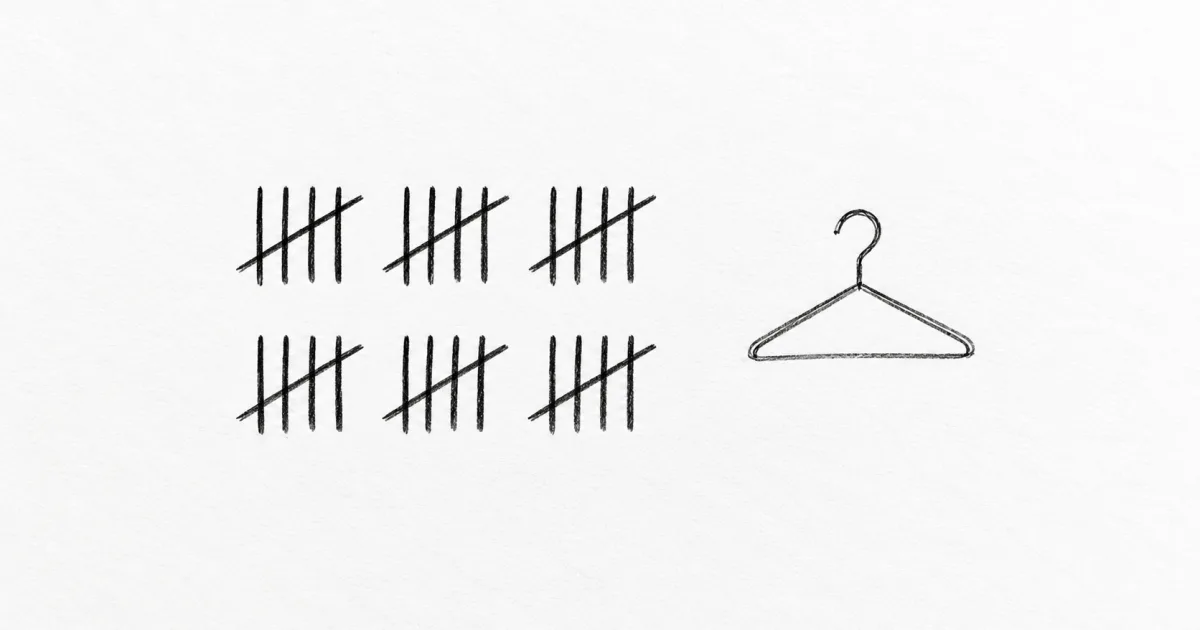
Standing in a changing room, holding something you quite like, ask yourself one question:
Will I wear this at least 30 times?
If the honest answer is yes, buy it. If it’s no, put it back. If it’s “maybe”, read on.
Where it comes from
The #30wears challenge was started by Livia Firth in 2015 as a simple counter to fast fashion. It went viral because it’s easy to remember and hard to argue with. Thirty is not a magic number — it’s just high enough to filter out the impulse buys and low enough to be realistic.
Why it works
Thirty wears forces you to imagine the future, which is exactly what a sale sticker stops you doing.
- A dress for one wedding? That’s 1 wear. Fail.
- A white t-shirt? Thirty wears in a single summer. Pass.
- Sequinned trousers you’d wear at Christmas? Ten years to reach thirty. Probably a fail.
It also reframes price. A £150 jacket you’ll wear 30 times costs £5 a wear. A £25 top you’ll wear twice costs £12.50 a wear. The jacket is cheaper.
The “maybe” pile
Most purchases live here. Three follow-up questions usually settle it:
- Does it go with three things I already own? If you’d need to buy something else to wear it, that’s a no.
- Would I wear it next week? Not “for the right occasion”. Next week.
- Is there something in my wardrobe already doing this job? If yes, this is a duplicate, not a discovery.
Check your own history
The best predictor of whether you’ll wear something 30 times is whether you’ve worn similar things 30 times. If you track your wears, you already know: your linen shirts get worn to death, your going-out tops don’t.
That’s the quiet superpower of counting. The rule stops being a guess and becomes a fact about you.
One caveat
The 30 wears rule is a filter, not a licence. Passing it doesn’t mean you need the item — it means the item won’t be a waste. “I don’t need this” is still a perfectly good reason to leave the shop.