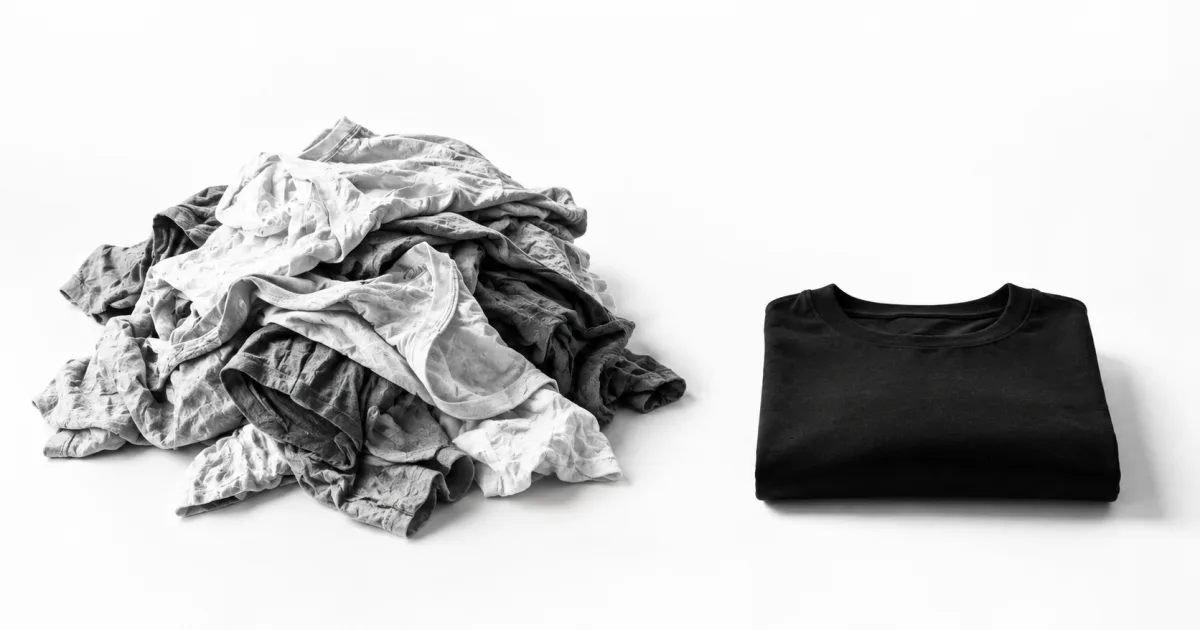
Nobody thinks they overspend on clothes. They think they get good deals. That’s the trick: a wardrobe full of good deals is usually the most expensive wardrobe of all.
The £8 t-shirt
Say you buy an £8 t-shirt. It looks fine for about ten washes, then the neck goes wavy and the fabric goes thin. You wear it 12 times. 67p a wear.
Now the £40 t-shirt. Heavier cotton, better stitching, holds its shape. You wear it 120 times over three years. 33p a wear.
The cheap one cost twice as much — and you’ll buy it again, and again, and again.
Why bargains feel free
Fast fashion prices are set to slip under the threshold where you’d stop and think. £8 doesn’t feel like a decision. But twelve of those in a year is £96, and most of them are in the bin.
Meanwhile the £40 t-shirt felt like a decision, so you made it once and carefully. That’s the whole difference.
The real costs nobody adds up
- Replacement. Cheap clothes are a subscription you didn’t sign up for.
- Storage. The things you don’t wear still take space, and space makes the things you do wear harder to find.
- Decision fatigue. A wardrobe of 200 mediocre items is harder to get dressed from than one of 40 good ones.
- The environmental bill. Cheap garments are cheap partly because someone else is paying — in water, in landfill, in labour. The UN Environment Programme has the numbers; they’re real even when they’re not on your statement.
The five-minute fix
You don’t need to swear off the high street. You need one number per item: what it cost, divided by how often you wear it.
Do this for a month and you’ll see something clear. The pieces you reach for aren’t the cheapest ones. They’re the ones that fit well, feel good and survive the wash. Once you can see that, cheap stops looking cheap — and quality starts looking sensible.
The rule of thumb
If you wouldn’t be a little sad to lose it, don’t buy it. Indifference at the till becomes indifference in the wardrobe, and indifferent clothes never get worn enough to be worth anything.